
Why I Wear a Marathon Arctic JDD in the Backcountry
I didn't expect a watch to change how often people look at my wrist. I expected a tool. Something I could rely on when I was deep in the backcountry, days from a power outlet, in weather that doesn't care what your gear costs. That's what I got with my Marathon 46mm Arctic JDD. What I didn't see coming was how often someone would notice it, ask about it, or quietly nod at it across a table.
This is a review of the watch I actually wear. Not the watch I tested for a week and sent back. Mine has been on every meaningful trip I have taken in the years I have owned it, and it has earned its place on my wrist through real use in rugged, remote locations.
What the JDD is
The 46mm Arctic Edition Jumbo Day/Date Automatic, model designation JDD, is a Marathon Search and Rescue series dive watch with a stark white dial. The Arctic dial was designed to reduce glare in bright snow or open country and to stay legible in daylight without squinting. The case is brushed 316L stainless steel, 46mm across and 18mm thick. The crystal is sapphire with an anti-reflective coating. Inside is a 26-jewel Sellita SW220 automatic movement with an Incabloc shock absorber. The watch is water resistant to 30 ATM, which is 300 metres.
It is hand-assembled in La Chaux-de-Fonds, Switzerland. The strap kit and bracelet options are manufactured in the same Swiss facility. Marathon was founded in 1939 by Morris Wein, and the company has been manufacturing timing instruments for Allied Forces since 1941. The SAR series, which the JDD belongs to, was developed to Canadian Government specifications for professional Search and Rescue operations. It remains standard kit for elite members of both the Canadian and U.S. militaries.
That is the spec sheet. The reason I wear it is what the spec sheet enables.
It works when you need it
The watch is automatic. Self-winding from the motion of my wrist. I don't carry a charger for it, I don't think about battery life, and it keeps time on a five-day pack-in the same as it does on a day at the office. For anyone who has had a smartwatch die on day three of a trip, you'll understand why this matters. The tool needs to work when you need it.
I have never owned a watch that I have stopped wearing because the battery died. I have stopped wearing other watches because the battery died, the charger was at home, and the watch became dead weight on my wrist. Mechanical watches don't have that failure mode. You wear it, it runs.
Reading the dial in any light
Every hour marker and every hand on the JDD carries a self-contained tritium gas tube. Tritium is a radioactive isotope of hydrogen that glows on its own through beta decay exciting a phosphor coating. No charging from sunlight, no winding of a luminous compound, no light source required. It just glows. The half-life is long enough that the tubes stay legible for decades.
There is a double tritium marker at twelve o'clock, which gives you instant orientation, and a MaraGlo pip on the bezel so I always know where the zero point sits in the dark. MaraGlo is the more traditional photoluminescent compound that needs sunlight or a flashlight to charge, but it is bright when you need it.
The practical result is that I can read the time in bright sun, in low light at last legal, and at three in the morning when I am checking how much sleep I have left before a stalk. No buttons to press, no screen to wake up. Look at your wrist and you have your answer.
A note on the 46mm size
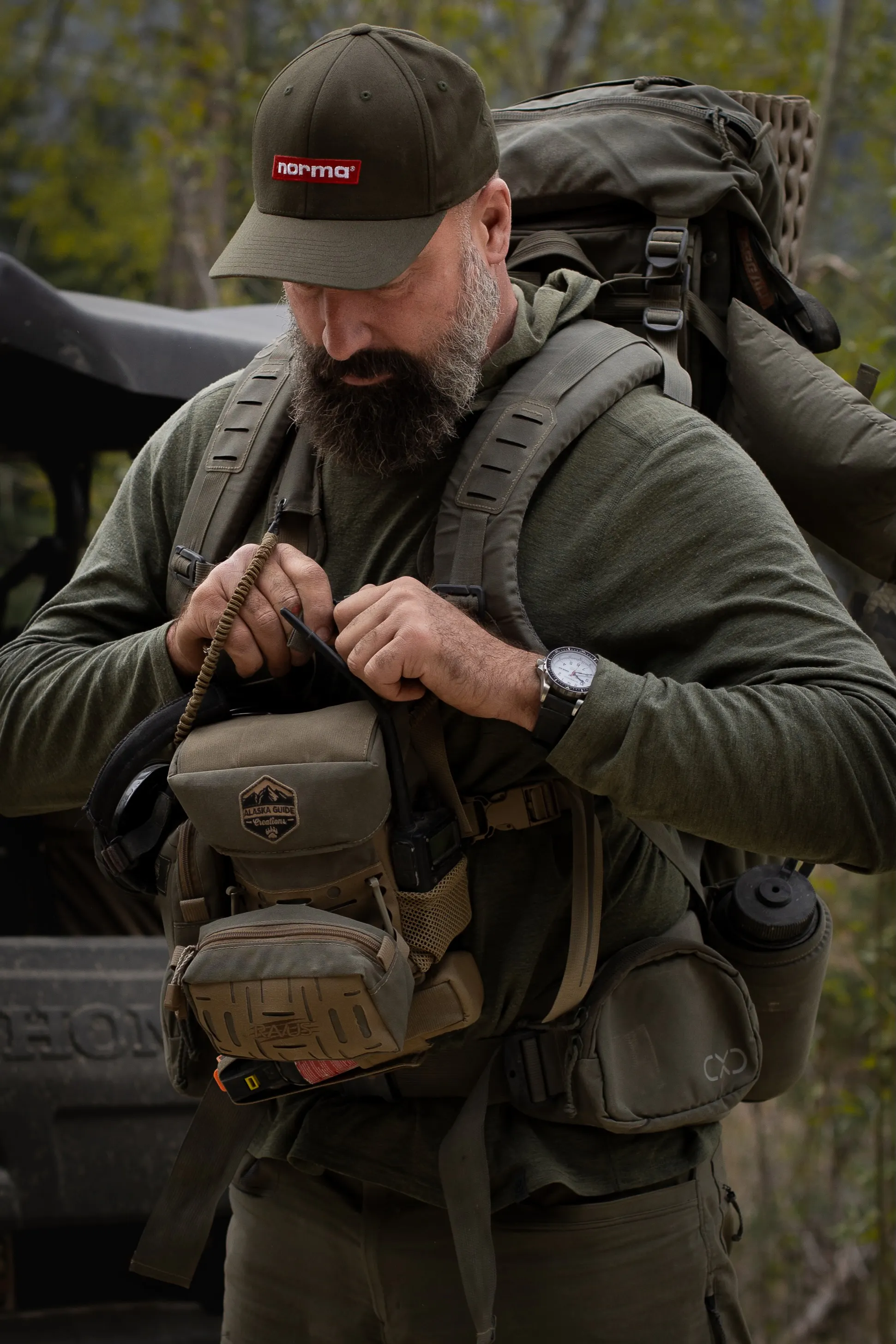
The JDD is a big watch. 46mm across, 18mm thick. I am a big fellow and it works well on me, but it is worth being honest about the size. If you have a smaller wrist, the watch will look like you are wearing a hockey puck.
Marathon makes the same SAR series in 41mm (GSAR) and 36mm (MSAR) cases. Both run the same Swiss build philosophy, the same tritium illumination, the same 30 ATM rating, and the same dive bezel. If the JDD is too much watch for your wrist, the GSAR is what most people who like Marathon end up wearing. The 46mm Arctic is the one I wear, and the dial real estate is part of why I like it. There is room for the day and date display in two languages, room for the inner 24-hour ring, and room for big legible numerals on the bezel.
Build quality I trust
I won't pretend I have put my Marathon through the kind of testing Armament Technology Incorporated does on a Tangent Theta scope. I have written about ATI's Halifax facility and the machines they built specifically to push their scopes past the point where most equipment fails. Marathon does similar work to military and SAR specifications, and the testing regime is part of why the SAR series ended up in the hands of search and rescue divers in the first place.
What I can speak to is what my JDD has been through. Rain, snow, brush, river crossings, scree falls, banged in tight bush planes, the inside of a truck box, the outside of a pack. It has been on hunting trips where I have come back with the strap caked in mud and the crystal scuffed against a rock face. It has been on the range in the cold and on float trips in the heat. It has not skipped a beat. It has not fogged. It has not lost time in any way I have been able to measure against a phone or a GPS.
That said, it gets noticed. I didn't realize until I started wearing one how often people look at a person's wrist. It is a conversation starter at the range, at industry events, and at coffee shops in town. The watch makes a statement without trying.
Using the bezel for navigation and pace counting
This is the part I want to spend the most time on, because it is the part most people miss.
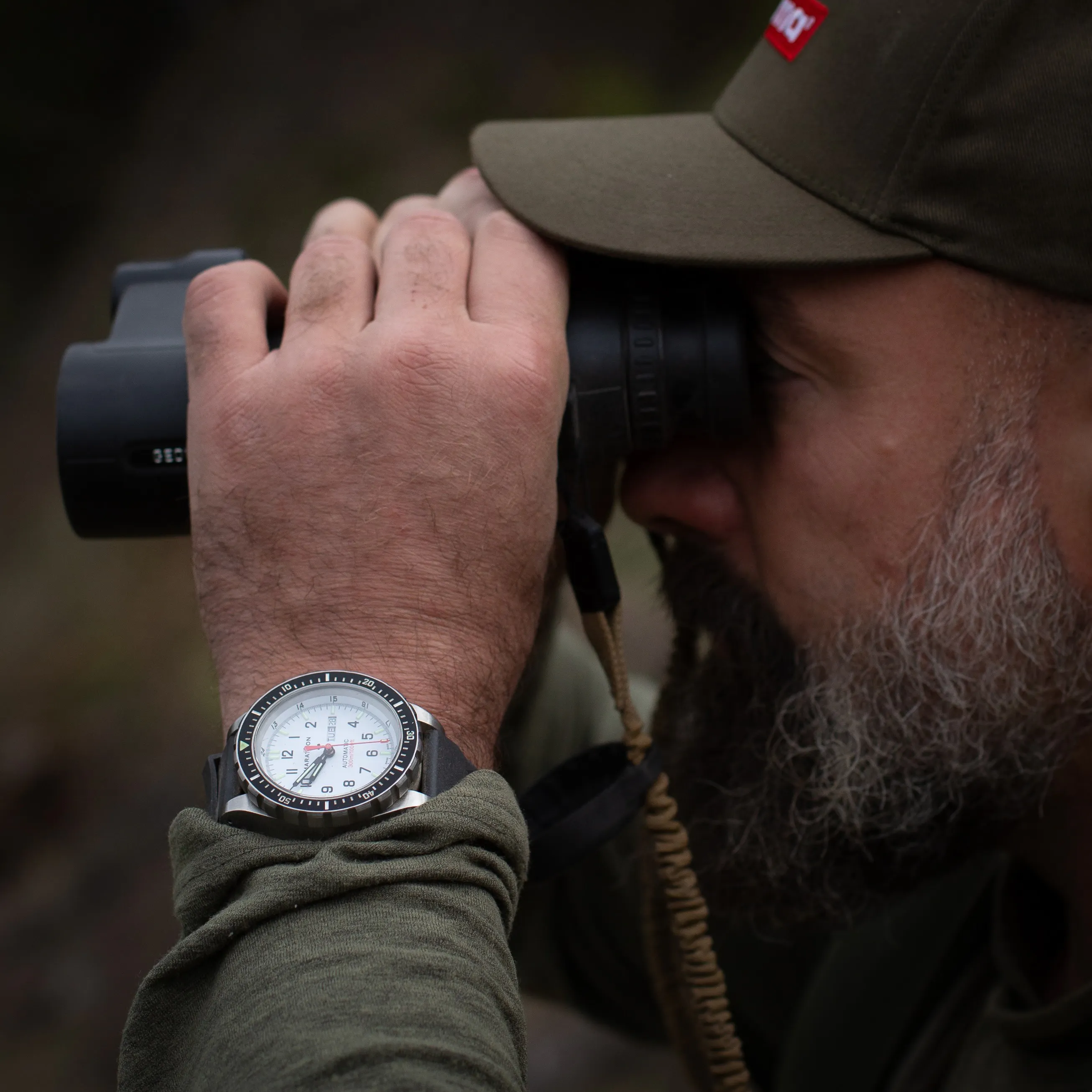
The bezel on the JDD rotates counter-clockwise only. That is standard for a dive watch. The idea is that if the bezel ever gets bumped underwater, it can only move in the direction that shortens your time, which keeps the diver honest about how long they have been down. The bezel has 60 click positions, marked in 5-minute increments on the dial. There is a second 13-24 hour ring on the inside for military time, which doubles as a quick reference for converting standard time to 24-hour format when reading a coordinate, a flight plan, or a hunting season closure time.
With an analog watch, you can find rough direction by pointing the hour hand at the sun and bisecting the angle between the hour hand and the twelve. In the northern hemisphere, that bisection points roughly south. South of the equator, you point the twelve at the sun and bisect to the hour hand to find north. It is not a replacement for a compass and map. It is a backup you are already wearing.
The more useful trick for me is pace counting.
Pace counting is how you measure ground distance on foot without a GPS. You count your paces over a known distance, calibrate the count to 100 metres, and then use it to estimate distance traveled in the field. Most people who learned pace counting in a military context use 65 paces per 100 metres. I have a longer stride and I have calibrated mine to 60 paces per 100 metres. Your number is your number, and the only way to find it is to walk a known distance on flat ground, then on slope, and count honestly. Your pace count on a packed gravel road is not your pace count on a sidehill through deadfall.
Here is how I use the bezel. I count one pace per two steps, on left foot strike. Every 60 paces, which is 100 metres for me, I click the bezel one position counter-clockwise. The bezel has 60 clicks, marked in 5-minute increments on the dial. Twelve clicks puts me at one kilometre. A full rotation logs twelve kilometres, then the bezel laps and I keep going.
No phone out, no GPS battery drain, no fumbling with a ranger bead string in the dark. Just a quiet click on the wrist every hundred metres. Combined with a compass bearing and a map, you can move through unfamiliar country with real precision. Think of it like an uber refined version of ranger beads.
If you have ever tried to estimate how far you have walked off a trail by feel, you know how badly your brain lies to you. The watch does not.
Why Canadian-Swiss matters to me
Marathon is owned and run from Canada. The watches are designed in Canada and built in Switzerland. That combination matters to me in the same way it matters that ATI builds Tangent Theta in Halifax.
There is a tendency to assume that the serious gear comes from somewhere else. American, German, Japanese, depending on the category. Canadian companies that build to the highest possible standard exist and they are worth supporting. Marathon has been doing it since 1939. ATI has been doing it since 1988. Both of them have built businesses on producing tools that allied militaries and professional users actually rely on, not on marketing.
When I picked up my JDD, part of what I was getting was the watch. Part of what I was getting was a relationship with a Canadian company that builds to standards I respect.
What I would change
Almost nothing. The JDD is a big watch and I am aware that the 18mm thickness is a lot for some shirt cuffs.
The day-date function is bilingual English and French, which is appropriate for a watch built to Canadian Government spec. Some people find the bilingual day wheel a bit busy. I do not, but it is worth mentioning.
The price is not low. The JDD on rubber strap starts at $2,100 USD, on bracelet at $2,500 USD. That is a serious purchase. I think it is worth it. I also think the GSAR, MSAR, and Marathon's quartz options give you a way into the brand at a lower entry point if the JDD is more watch than you need.
If you are thinking about a Marathon
The honest answer is that you should buy one when you are ready to keep it for decades, not as something to try out. Marathon does not run discounts on their direct site, which is appropriate for a brand built around durability and longevity rather than seasonal turnover.
There is one working partner discount. Through the Silvercore Club, members get 10% off any Marathon order plus a free glow-in-the-dark clip compass on orders over $50 CAD. If you are in the market for a Marathon and you are not already a Club member, the full breakdown of the Marathon Watch discount and the math on the membership is here.
If you want to read more about Canadian companies building world-class tools, my review of Tangent Theta and what I saw inside ATI's Halifax facility is here.
Travis Bader Silvercore Outdoors


