
SAI Optics SAI 6 1-6x24 Review: A Canadian-Designed LPVO on a Sako 90 Finnlight
Recently, I found myself in the Swedish forest on a driven hunt, hosted by Norma. Driven hunts are a tradition in much of continental Europe and they look almost nothing like the still-hunting and spot-and-stalk that most Canadian hunters grow up with. You stand at a designated post. Dogs and beaters work through the forest in your direction. Game breaks cover at thirty metres, sometimes ten, sometimes closer, moving fast, and the window to take an ethical shot is measured in seconds.
I had grown up, like most North American shooters, leaning toward higher-magnification scopes. Three to nine had been the family rifle for decades, and as my interests pulled toward longer ranges and precision shooting, I crept up from there. Four to sixteen. Five to twenty-five. Anything that could resolve a target at a thousand yards was a scope I wanted to look through. Low-power glass felt like a compromise. It was for people who were on tight budgets, or for shotguns in slug country.
Standing on that post in Sweden, watching a wild boar break cover and cross the lane at a hard angle, I learned in about three seconds why the Europeans favour the optics they favour. A high-magnification scope on driven game is not just unhelpful, it's actively dangerous. You can't find the animal in the eyepiece. By the time you do, the safe shot window has closed. The hunters around me were all running 1-6, 1-8, and 1-10 LPVOs and they hit what they aimed at, cleanly, repeatedly, and without drama.
That experience stuck with me. Years later, I had reason to put it into practice on a rifle of my own.
The rifle: Sako 90 Finnlight in .308 Winchester
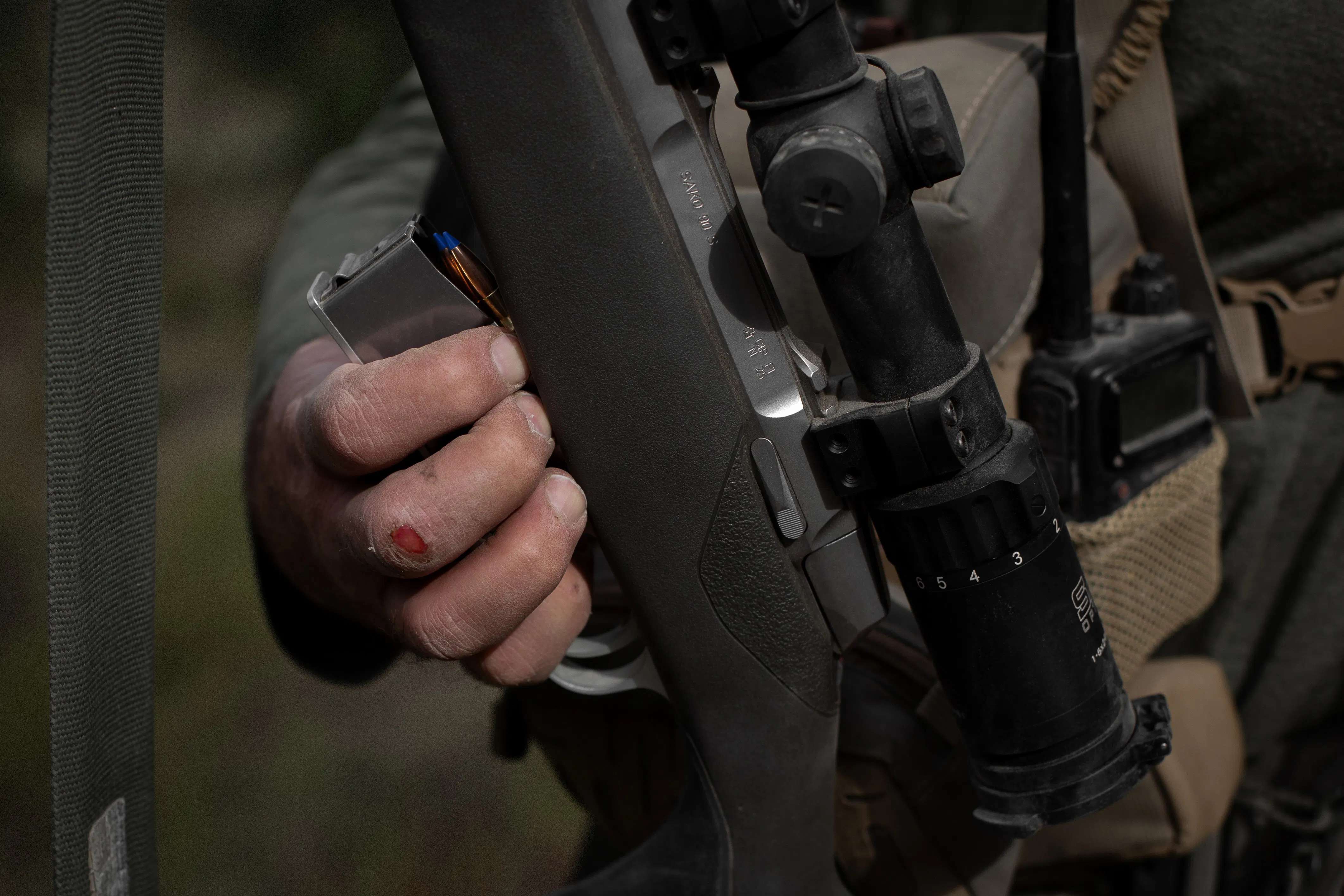
The Sako 90 Finnlight is built to be carried. Stainless steel, a lightweight synthetic stock, fluted barrel, the whole package weighing in around six and a half pounds before optics. It's the kind of rifle that gets lighter the harder the country gets. Chambered in .308 Winchester, it's a generalist's hunting rifle. Deer, black bear, elk in close cover, the kind of work most Canadian hunters actually do.
The mistake a lot of people make with a rifle like this is bolting a five-pound competition scope to the top of it. You can do it. The rifle will shoot. But you've now defeated the point of the rifle, which was to be light and fast in the hand for the kinds of hunts where weight matters by the end of the day.
I wanted glass that matched the rifle's purpose. Light, durable, fast at close range, capable enough at distance for the work this rifle would actually be asked to do. That ruled out most of my safe full of high-magnification scopes and pointed straight at the LPVO category.
Why I chose the SAI 6
For readers who haven't followed Silvercore long, I should explain the connection. SAI Optics is made by Armament Technology Incorporated, the same Halifax-based Canadian company that makes the Tangent Theta. I wrote at length about my visit to ATI in The World's Best High-End Rifle Scope, where I got to see their drop test machines, their Class 100 clean room, and the people building scopes that hold up to standards most optics manufacturers don't even test for.
A common question I see online is where SAI scopes are actually made, and ATI has been straightforward about this. On Episode 90 of the Silvercore Podcast, ATI's VP of Sales Trevor Publicover put it plainly: "SAI Optics, we've aided in the design. We don't make it here, it's made for us in Japan." The glass elements come from a mix of sources --Germany, Japan, and Asia -- depending on the spec, the same way they do for almost every premium optic on the market. The normally reserved and highly technical optical engineer Ilya Koshkin (The Dark Lord of Optics) called SAI "the Japanese-made Tangent Theta" and I have to agree with him.
What sets the SAI line apart from most overseas-manufactured scopes is what happens after the units arrive in Halifax. Trevor said it directly on that same podcast: "We also run all those same tests on all of the other scopes that we sell, even though we don't make them. We wanna make sure that everything we sell gets held up to the same standard." The same drop testing, the same leak testing, the same temperature qualification that every Tangent Theta gets put through is applied to SAI as well. ATI doesn't have a warranty department because their scopes don't fail enough to need one, and the testing discipline is the reason why.
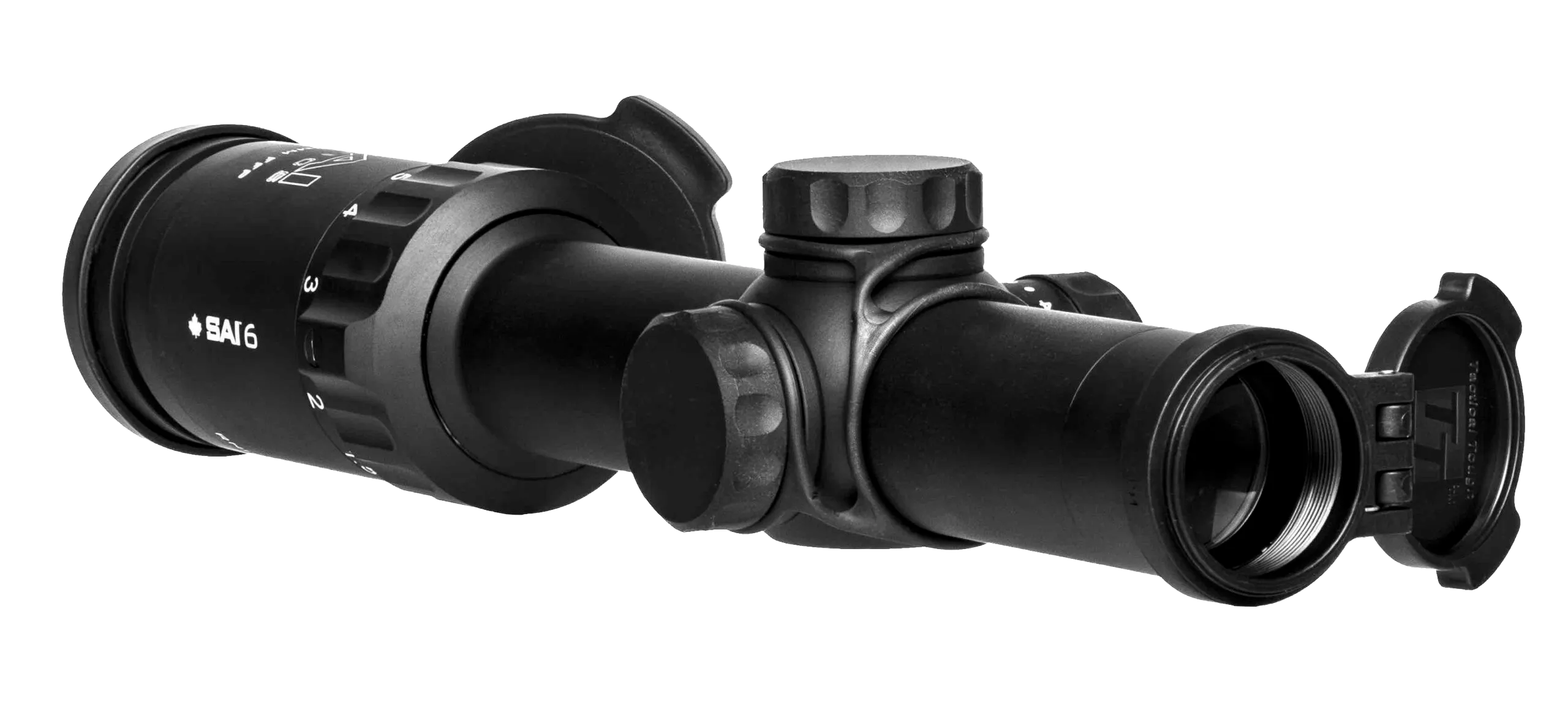
The SAI 6 1-6x24 is the LPVO in that family. First focal plane reticle, 30mm tube, etched MIL reticle, and LED illumination.
ATI offers the SAI 6 with two reticle options. The MIL with their Rapid Aiming Feature, which adds a large open X around centre that pulls the eye to centre at low magnification for fast target acquisition. And the MIL without RAF, which keeps the precision aiming elements and ranging features without the X. Same scope underneath, two different philosophies for what you want the reticle to do.
The RAF reticle has a specific design intent. Trevor explained it on the podcast: "It was designed originally in a scope that was to bracket a torso from shoulder to hip, right? And that X-Wing fighter look that some people call it, that's at a hundred meters. It's for fast acquisition and really draws your eye to the center of the target." The target audience was three-gun shooters and reactive applications where the priority is getting on a man-sized target fast. The reticle does exactly what it was designed to do. Whether you want it depends on whether your shooting is more about quick acquisition or measured holds.
The one I mounted on the Finnlight is the MIL No-RAF. My reasoning was simple. On a hunting rifle in .308, I expect to take measured shots more often than reflexive ones, even at LPVO distances. I'd rather have an uncluttered sight picture and lean on the precision elements when I need them. I am so impressed with this scope that I can see myself getting the RAF variant and mounting it on a different rifle to compare the two side by side, but that's a post for another day.
What you get out of the box
Out of the box, the SAI 6 comes packaged the way an ATI product should. Tenebraex flip caps front and back, a killFlash anti-reflection device that threads to the objective, tethered turret caps so they don't go missing on the range floor, and a battery removal disc. ATI owns Tenebraex, so the accessories aren't aftermarket. They're designed to fit. That detail matters more than it sounds. I've owned plenty of scopes where the included caps were an afterthought you replaced within a week.
The scope itself weighs eighteen ounces. On the Finnlight, that brings the whole package in well under nine pounds ready to hunt. That's a noticeable difference if you've ever carried an eleven-pound rifle up a mountain.
On the range
I mounted the SAI 6 in MDT 30mm Elite rings, levelled it, torqued it, and headed to the range. Bore-sighted, then zeroed at 100 yards with three rounds. The turrets are tactile and clean. Not the "clickiest clicks in the industry" promise that ATI makes for Tangent Theta, but distinct, repeatable, and reassuring. They track. That's what you actually need from turrets.
The MIL No-RAF reticle resolves cleanly across the magnification range. At 1x with both eyes open, the scope behaves almost like a red dot. The illuminated centre dot picks up easily, the rifle goes where you're looking, and you get on target fast. At 6x, the reticle is what you want it to be for measured shots: clean centre, usable holdover and wind grid, a ranging bracket for known-size targets. It does precisely the job a precision-focused FFP LPVO should do. The trade-off, for anyone considering the RAF variant instead, is that the No-RAF reticle does ask more of you at 1x. There's no big X to catch the eye. You're aiming with a fine reticle and the illumination, the way you would on any precision FFP scope. For my use, that's fine. For someone primarily shooting reactive targets at close range, the RAF would probably be the better call.
The glass is good. Not Tangent Theta good. That's not a fair comparison and it's not what this scope is. But well above what I would have expected for the price. Edge-to-edge clarity is clean, the illumination is properly daylight-bright on the upper settings without bleeding the reticle, and the eye box is forgiving enough that getting behind the scope quickly doesn't require head gymnastics.
Parallax on the SAI 6 is fixed at 100 yards. There's no side focus to fiddle with, which is the right call for a 1-6 scope. The mechanical depth of field at low power is wide enough that parallax error inside typical hunting distances is essentially a non-issue, and that brings me to a habit worth explaining.
A note on parallax and magnification
When I shoot competitively, I often dial a high-magnification scope back to 10x maximum, even when the target is further. The reason is that the visible effect of parallax error gets worse as magnification increases. The underlying optical condition doesn't change, but at 25x a small head-position error produces a reticle that's wandering noticeably across the target. At 10x the same head movement barely shifts the reticle. I can quarter the target with the reticle to get accurate hits, hold my own zero, and shoot faster because I'm not fighting the optic.
On a fixed-parallax 1-6 LPVO, that whole concern compresses into the magnification range itself. From 1x to 6x, you're operating in a band where parallax error simply doesn't have room to be a problem. That's the design decision ATI made, and it's correct for the use case.
What the SAI 6 is for, and what it isn't
I want to be honest about where this scope shines and where it doesn't.
The SAI 6 is for close to medium-range work where speed matters and shot windows are short. Driven hunts. Black bear over bait at fifty yards. Deer in thick timber. Three-gun and similar competitions. Defensive applications where the rifle is a working tool, not a precision instrument. That isn't to say you can't comfortably take longer shots with it, I would think most people would find it works exceptionally well for hunting up to 300 m. Traditionally, 6x was considered the "do-it-all" hunting magnification for good reason.
If you are looking at shooting prairie dogs at six hundred yards, picking apart a precision rifle stage at a thousand, or stretching the .308 to its ballistic limits in open country, there are better scopes for that work and you already know what they are.
The Finnlight in .308 happens to be a rifle that mostly lives in the SAI 6's lane. Most of my hunting with that rifle is in cover at sensible distances. When I need to reach out, I have other rifles for it. If you tried to make one rifle and one scope do everything, you'd compromise both. Match the optic to the rifle's purpose, and the SAI 6 earns its place on a light, fast hunting rifle in a way that a 5-25 simply doesn't.
The price problem, and how to solve it
The SAI 6 1-6x24 retails for $1,335 USD on armament.com, which works out to roughly $1,860 CAD at current exchange rates. That's a real number for a working hunter, even for one of the better LPVOs on the market.
Here's the part most reviews won't tell you. If you're a Silvercore Club member, you get 15% off SAI Optics, 10% off Tangent Theta, and 20% off Tenebraex products. The full breakdown of how those discounts work is in Tangent Theta, SAI & Tenebraex Discounts | Silvercore Club, including the math on a Tangent Theta order where the discount alone is worth more than the membership fee by an order of magnitude. The same math applies to SAI. The 15% discount on a $1,335 USD scope works out to about $200 USD off. The Silvercore Club membership is $59 CAD a year. You don't need to be a math major to see how that pencils.
I'll be direct about the business case. The Silvercore Club exists for a lot of reasons. It is an RCMP-approved ATT club. It comes with North America-wide liability insurance. It opens access to The Outpost, our member-only podcast. But the discount program is the part that actually saves members money in cash, on day one, on things they were already buying. If you're shopping ATI optics, the membership pays for itself before you've even shipped the order.
The final word
The SAI Optics SAI 6 1-6x24 is a serious LPVO from a serious Canadian company. On the Sako 90 Finnlight in .308, it's a near-perfect match. Light, fast, durable, with glass and a reticle that punch above the price point. It's a hunting and working scope, not a precision target scope, and the people who'll be happiest with it are the people who understand what an LPVO is actually for.
Worth knowing too: the SAI 6 is the first in what ATI describes as a family of scopes. Trevor confirmed on the podcast that more magnifications and reticle options are in development, including a straight mil-tree reticle and likely a MOA version and the soon to be released SAI 10. The 1-6 is where they started. If you're buying into SAI now, you're buying into a Canadian-designed LPVO line that's expanding rather than a one-off.
I came to LPVOs late, by way of a Swedish forest and a hunt I didn't know I was about to learn from. The shooters around me on that hunt had figured this out a long time before I did. The SAI 6 is the scope I wish I'd had on my back that week.
For the full conversation with Trevor on ATI, SAI Optics, and the testing standards behind everything they sell, listen to Episode 90 of the Silvercore Podcast: The Rolls Royce of Rifle Scopes.
Travis Bader
Silvercore Outdoors
Related Posts
View all Posts
Do Treaty Rights Holders Need a PAL to Hunt?
Read more
Back-to-School Wild Meals: Fast Weeknight Dinners From the Freezer
Read more
Top-Rated Range Instructors in BC: What to Look For
Read more
Reputable Firearms Licensing Instructors in BC: How to Check
Read moreWhere to Get a BC Hunting Licence (Online, Office or Vendor)
Read moreHow to Get Your FWID in BC (Fish and Wildlife ID)
Read more